NASA’s Quesst
To Change The Supersonic Speed Limit
NASA’s Quesst mission may open the future to a new market of commercial supersonic air travel by cutting flight times in half. Learn more about the 50+ year old ban on commercial supersonic travel over land and what NASA is doing to change the speed limit in the sky to a sound limit.
The Quesst mission’s goals are to design and build NASA’s X-59 research aircraft with technology that reduces the loudness of a sonic boom and fly the X-59 over several U.S. communities to gather data on public responses to the sound generated during supersonic flight and deliver that data set to regulators.
Meet some of the Quesst subject matter experts including the X-59’s Lead Test Pilot, Nils Larson and Aerospace Engineers, Cathy Bahm and Larry Cliatt.
Admission grants free entry to this event. Tickets are available online and at the Museum admissions desk.
K-12 Educators: You can earn 2 CPE credits while attending this event! Visit our Information Table at the event to sign in and receive our tracking sheet. You may earn up to 2 credit hours for attending the presentation and activity tables! You will receive your certificate after turning in our tracking sheet. Pre-registration is required; please email education@flightmuseum.com to gain access to our form.
The Subject Matter Experts
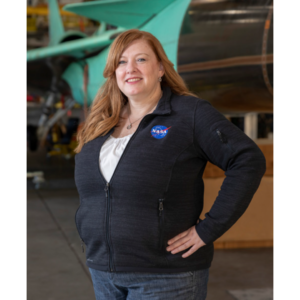
Catherine M. Bahm, Low Boom Flight Demonstrator Project Manager
Catherine M. Bahm is the project manager for NASA’s Low Boom Flight Demonstrator project, leading the development and testing of the X-59, a quiet supersonic aircraft. With nearly three decades at NASA, she has held key roles in Orion flight tests, technology demonstration missions, and aeronautics research. Starting as a cooperative education student in 1993, Bahm has contributed to projects like X-43A and sonic boom research. She holds bachelor’s and master’s degrees in aeronautical engineering from Texas A&M University and has received multiple NASA awards for her leadership and technical achievements.
View Cathy’s official NASA biography to learn more.
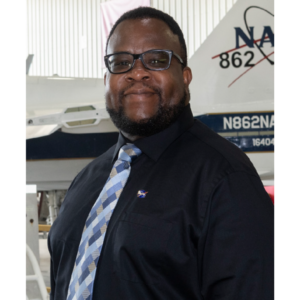
Larry J. Cliatt II, NASA Armstrong Aerospace Engineer
Larry J. Cliatt II is an aerospace engineer and sub-project manager at NASA’s Armstrong Flight Research Center, overseeing the acoustic validation phase of NASA’s Quesst mission. Specializing in sonic boom flight research and high-speed aerodynamics, he has led key projects like WSPR, FaINT, and QSF18. A NASA FIRST leadership program graduate, Cliatt has received multiple NASA awards, including the Early Career Achievement Medal. He holds bachelor’s and master’s degrees in aerospace engineering from Georgia Tech and is a long-standing member of the National Society of Black Engineers.
View Larry’s official NASA biography to learn more.
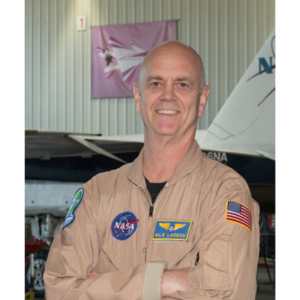
David Nils Larson, NASA Test Pilot
David Nils Larson is a research test pilot at NASA’s Armstrong Flight Research Center and the lead pilot for the X-59, an experimental aircraft designed to reduce the intensity of sonic booms. With over 7,000 flight hours in more than 100 aircraft, Larson has played a key role in supersonic research, high-speed propulsion projects, and airborne science missions. A retired U.S. Air Force lieutenant colonel, he previously served as chief pilot at NASA Armstrong. Larson holds a degree in astronautical engineering from the U.S. Air Force Academy and is a fellow and past president of the Society of Experimental Test Pilots.
View Nil’s official NASA biography to learn more.
The Moderator
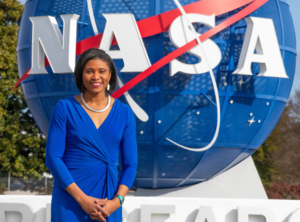
Brittny McGraw, NASA’s LRC News Chief
Brittny McGraw is the News Chief at NASA’s Langley Research Center, bringing two decades of experience as an award-winning broadcast journalist. Before joining NASA in 2023, she reported in cities across the U.S., using her storytelling skills to inform and inspire communities. A graduate of the University of North Carolina at Chapel Hill, McGraw holds degrees in Journalism and Mass Communication and Romance Languages. Passionate about effective communication, she is dedicated to sharing NASA Langley’s groundbreaking work with the world.